What can pet rats eat?
What’s suitable, what only in small amounts, and what is toxic – every answer with a source. The basis is a dry food made for rats, plus a little fresh food every day.
Toxic
Toxic to rats. Rats can’t vomit, so the RSPCA warns that even a small amount of something harmful can kill them. If you’re worried your rat has come into contact with anything harmful, the RSPCA says to contact your vet immediately.
Better not
Sources advise against it or disagree, so we err on the side of caution.
Only a little
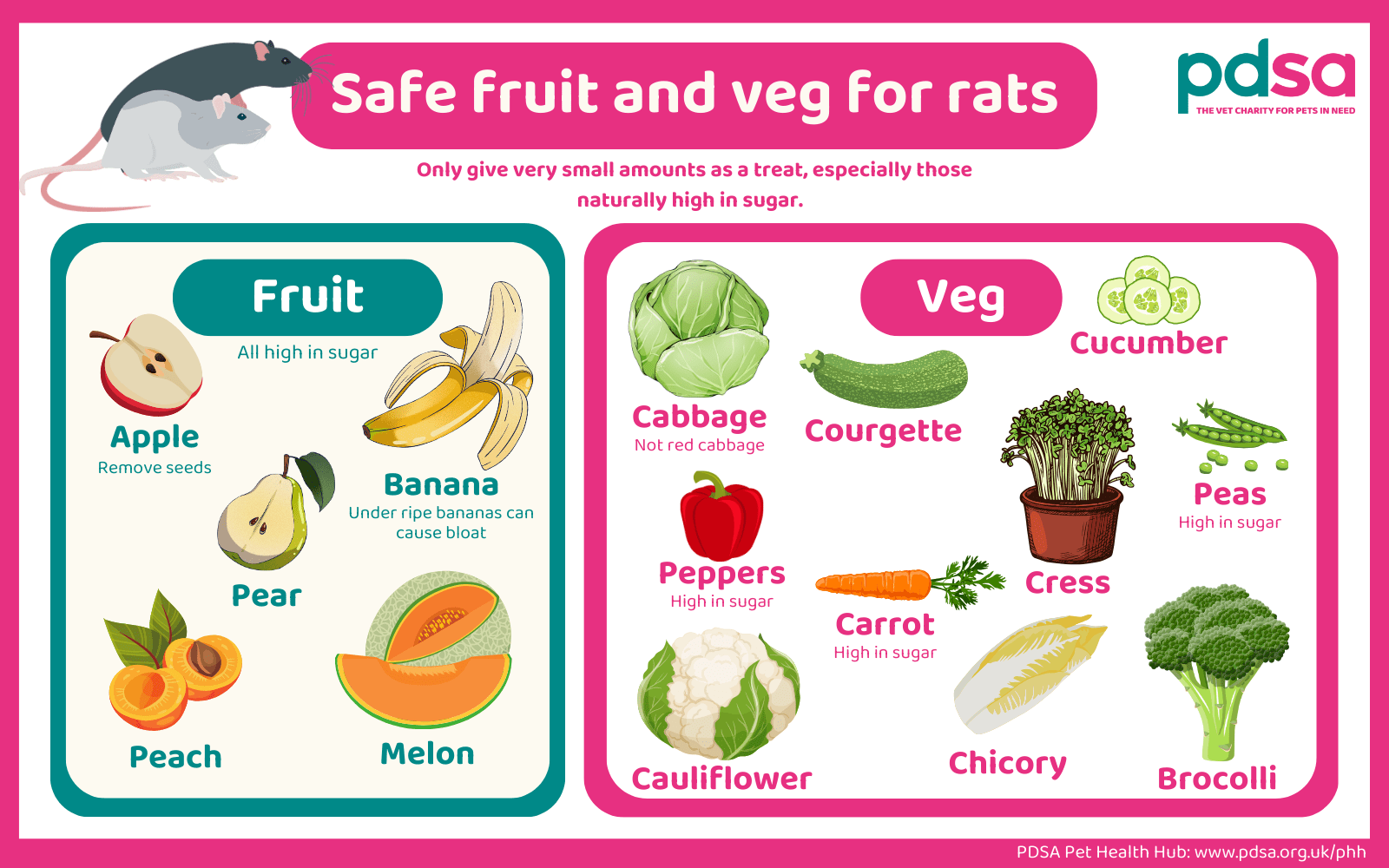
Only now and then and in small amounts. The PDSA says to give fruit only in very small amounts as a treat, since it is high in sugar.
- Apples
- Bananas
- Beans: Only a little, cooked
- Bell peppers
- Blueberries, raspberries and other berries
- Branches and leaves
- Carrots
- Corn
- Dandelions and meadow plants
- Dates and figs
- Dog food and cat food
- Eggs: Only a little, cooked
- Fish and shrimp: Only a little, well cooked
- Hay
- Hazelnuts and other nuts
- Herbs (parsley, basil, mint …)
- Kiwi
- Lentils and chickpeas
- Mealworms and insects
- Meat and chicken: Only a little, well cooked
- Melon
- Oats and breakfast cereal
- Pasta
- Peaches
- Peanuts
- Pears
- Peas
- Popcorn
- Potatoes: Only a little, cooked
- Rice and rice cakes
- Strawberries
- Sunflower seeds, pumpkin seeds and flaxseed
- Tomatoes
Yes, in small amounts
Suitable in small amounts: the PDSA recommends small amounts of fresh food every day, and the RSPCA says to give it as part of the daily food allowance, not on top of it.
Other animals
- What can dogs eat?What’s fine in small amounts, what doesn’t belong in the bowl and what’s toxic. Every answer has a source, and treats come with the right amount.
- What can cats eat?What’s fine in small amounts, what doesn’t belong in the bowl and what’s toxic. Every answer has a source, and treats come with the right amount.
- What can rabbits eat?What works as fresh food, what only now and then, and what is toxic – every answer with a source. Hay always remains the basis.
- What can guinea pigs eat?What works as fresh food, what only now and then, and what is toxic – every answer with a source. Hay remains the basis, plus vitamin C every day.
- What can horses eat?What’s fine as a treat, what only in small amounts, and what is toxic – every answer with a source. Forage such as hay remains the basis.
- What can hamsters eat?What’s fine as fresh food or a treat, what only in small amounts, and what is toxic – every answer with a source. A good dry food remains the basis.
- What can chickens eat?What’s fine as a treat, what only in small amounts, and what is toxic – every answer with a source. A complete layer feed remains the basis.
- What can budgies (parakeets) eat?What’s fine as fresh food or a treat, what only in small amounts, and what is toxic – every answer with a source. Budgerigars are commonly called budgies or parakeets (AAV). A good seed mix or pellet diet remains the basis.
- What can chinchillas eat?What’s suitable, what only in small amounts, and what is toxic – every answer with a source. Hay remains the basis, at all times.
- What can cockatiels eat?What’s suitable, what only in small amounts, and what is toxic – every answer with a source. A seed mix or pellets remain the basis, plus a little fresh food every day.
- What can degus eat?What’s suitable, what only in small amounts, and what’s better not – every answer with a source. Hay remains the basis, and it should always be available.
Questions
What is toxic to rats?
Avocado: the Merck Veterinary Manual names rats among the animals that can become ill from it, and the Swiss animal welfare society (STS) lists it as poisonous or dangerous. None of our rat sources clearly calls onions and garlic, rhubarb or chocolate toxic: the RSPCA counts onions, rhubarb and chocolate among harmful foods, RSPCA Australia adds garlic, the STS lists onions and garlic as poisonous or dangerous, and for chocolate the Merck Veterinary Manual says small amounts don’t cause poisoning. That’s why we rate them “Better not” – like grapes, raisins, citrus fruits and walnuts, which the RSPCA also calls harmful. Rats can’t vomit, so the RSPCA warns that even a small amount of something harmful can kill them. If you’re worried your rat has come into contact with anything harmful, the RSPCA says to contact your vet immediately.
What is the right basic diet for rats?
A dry food made specifically for rats: the RSPCA says pellets for rabbits, guinea pigs or hamsters won’t give rats the nutrients they need. Sources disagree on which kind. The RSPCA, PDSA, RSPCA Australia, Merck, the University of Liverpool’s veterinary practice and Tufts recommend rat pellets or nuggets. RSPCA Australia says seed mixes are not a good choice, Tufts says they are high in carbohydrates and fat and not healthy, and Merck says rats often pick out the seeds and leave the pellets. The Swiss animal welfare society (STS), Switzerland’s federal veterinary office (BLV) and the Zurich animal welfare society (Zürcher Tierschutz), on the other hand, name a grain or dry food mix as the basic diet, Woodgreen a good-quality, complete dry mix, and Germany’s Veterinary Association for Animal Welfare (TVT) notes that commercial rat food is mostly grain mixes. Merck says to change the diet gradually.
How much food does a rat need per day?
Sources give different amounts: Woodgreen about 15 g of dry food per rat per day (around two tablespoons), the STS about 22 g of grain food, and the Zürcher Tierschutz about one tablespoon for an adult rat. Rats gain weight easily, says the PDSA, and Merck says obesity in pet rats is common – follow the feeding guidelines on the package and weigh the food out each day (PDSA). The RSPCA says to feed twice a day, morning and evening, and to adjust the amount so your rats eat all of it and stay a healthy weight. These are starting points – your rat’s weight shows whether the amount is right.
How often should rats get fresh food?
Every day in small amounts (PDSA, Zürcher Tierschutz) – as part of the daily food allowance, not on top of it, says the RSPCA. The STS says to remove uneaten fresh food every day. The PDSA says to give fruit only in very small amounts, since it is high in sugar.
How many treats are okay?
RSPCA Australia says treats should make up no more than 10% of the calories your rats need, and Woodgreen suggests treats a few times a week. Merck says to avoid fatty treats because older rats are prone to obesity, and the RSPCA says to use foods high in fat or sugar only as occasional treats or training rewards. Rats on a good commercial mix don’t need extra animal protein, says the Zürcher Tierschutz, so offer it at most once or twice a week in small amounts.
Water: bottle or bowl?
Fresh water must always be available – sources differ on how. The RSPCA recommends bottles rather than bowls to avoid contamination, refilled twice a day, and Merck says rats may spill water from a dish or push bedding into it. The Zürcher Tierschutz, on the other hand, prefers a bowl to a bottle, and the STS mentions both, open clay bowls or bottles. Change the water every day (STS, TVT).
What else is dangerous?
RSPCA Australia lists coffee, tea and alcohol as potentially harmful, plus sticky foods that could be a choking hazard, and the University of Minnesota says rats should never be fed alcohol. The STS also lists wild garlic, peanut butter (choking hazard), carbonated drinks (rats can’t burp), stale food, green bananas, and raw potatoes, raw cabbage, raw artichokes and raw beans as poisonous or dangerous. Rats can’t vomit, so the RSPCA warns that even a small amount of something harmful can kill them. If you’re worried your rat has come into contact with anything harmful, the RSPCA says to contact your vet immediately.
What should I do if I suspect poisoning?
The RSPCA says to make sure your rats can’t access or eat poisonous materials, including poisonous food, plants and chemicals. Rats can’t vomit, so the RSPCA warns that even a small amount of something harmful can kill them. If you’re worried your rat has come into contact with anything harmful, the RSPCA says to contact your vet immediately.
My rats eat their poop – is that normal?
Yes. The RSPCA says rats need to eat fresh feces – it’s natural behavior that helps them absorb all the nutrients and minerals. The Merck Veterinary Manual also calls it normal behavior.
What if the sources disagree?
Then we rate it more cautiously and say so. The STS and the University of Liverpool’s veterinary practice count fruit as daily food, while the PDSA, RSPCA Australia, Merck and the Zürcher Tierschutz say only a little – we rate all fruit “Only a little.” The RSPCA calls grapes harmful, while Woodgreen lists them as a treat and the Zürcher Tierschutz says occasionally; the RSPCA calls walnuts harmful, while the Zürcher Tierschutz calls tree nuts well suited. Woodgreen, the University of Minnesota and the STS mention bread, while the Zürcher Tierschutz says never. The PDSA, RSPCA Australia and the University of Minnesota mention broccoli and cauliflower, while the Zürcher Tierschutz calls all kinds of cabbage unsuitable. The TVT, STS, Royal Veterinary College, University of Minnesota and Zürcher Tierschutz allow cheese or yogurt in small amounts, the RSPCA says to use dairy only as a treat, and RSPCA Australia advises against it. For chocolate, Merck says small amounts don’t cause poisoning, while the RSPCA, RSPCA Australia and the University of Minnesota advise against it. We rate all of these “Better not.” Sources also disagree on the basic diet (pellets or grain mix) and on water (bottle or bowl).
Sources
- RSPCA – What to feed rats
- RSPCA – Rat health and welfare
- PDSA – Rats as pets (What to feed your rats)
- PDSA – Safe fruit and veg for rats (infographic on “Rats as pets”)
- Woodgreen Pets Charity – What do rats eat? Feeding tips & homemade rat food recipe
- Woodgreen Pets Charity – Caring for rats as pets
- RSPCA Australia – What should I feed my rats?
- Merck Veterinary Manual (Pet Owner Version) – Providing a Home for a Rat
- Merck Veterinary Manual – Mice and Rats as Pets (Exotic and Laboratory Animals)
- Merck Veterinary Manual – Avocado (Persea spp) Toxicosis in Animals
- University of Liverpool, University Veterinary Practice – Care of pet rats
- Tufts University (Cummings School of Veterinary Medicine) – Five Things to Know About Rats (2020)
- Royal Veterinary College – Caring for your rat
- University of Minnesota – Veterinary Preventive Medicine (2022), Chapter 15: Mammals I
- TVT Merkblatt Nr. 160: Heimtiere – Ratten (2014)
- Schweizer Tierschutz STS – Merkblatt Heimtiere: Ratten
- BLV (Swiss Federal Food Safety and Veterinary Office) – Nager: Ratten
- Zürcher Tierschutz (Zurich animal welfare society) – Farbratten: Haltung
- Zürcher Tierschutz (Zurich animal welfare society) – Farbratten: soziale Schlauköpfe (guide)
Last checked: November 2026