What can degus eat?
What’s suitable, what only in small amounts, and what’s better not – every answer with a source. Hay remains the basis, and it should always be available.
Better not
Sources advise against it or disagree, so we err on the side of caution. Germany’s TVT says degus should not be given fruit at all.
- Apples
- Bread
- Broccoli and cauliflower
- Cabbage, Brussels sprouts and bok choy
- Cardboard
- Chinchilla and guinea pig food
- Corn
- Dried fruit (raisins, banana chips)
- Eggs, cheese and yogurt
- Fruit
- Grains (oats, wheat)
- Mealworms, insects and meat
- Onions, leeks and chives
- Rabbit, hamster and gerbil food
- Rose hips
- Treat sticks, drops and sugary snacks
Only a little
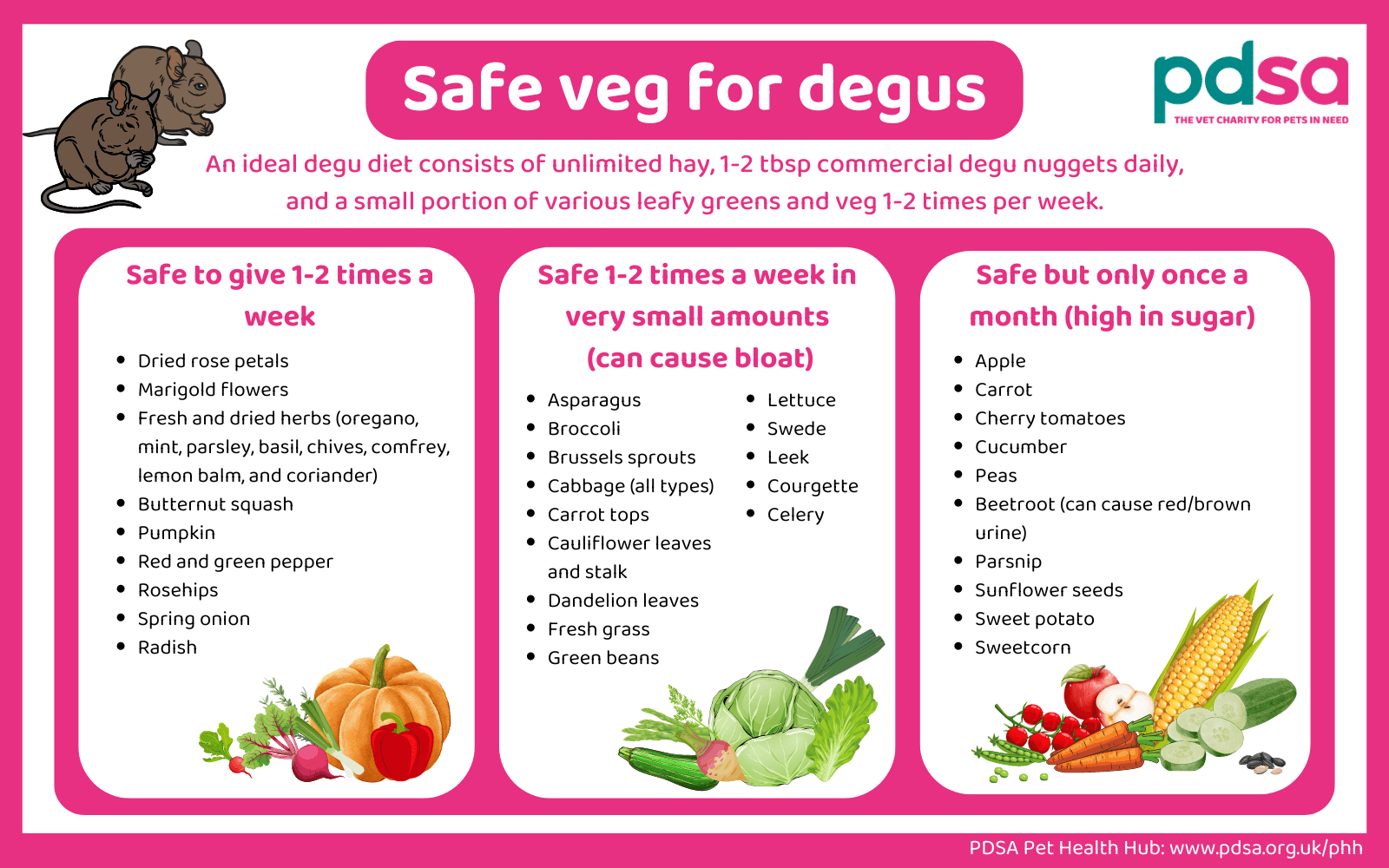
Only now and then and in small amounts. PDSA suggests a small portion of leafy greens and vegetables only once or twice a week, and the Swiss animal welfare society (STS) 2 to 3 times a week in small pieces.
- Asparagus
- Beets
- Bell peppers
- Carrot tops
- Carrots
- Celery
- Cherry tomatoes
- Chicory and radicchio
- Cucumber
- Dandelions
- Fennel
- Fresh grass
- Lettuce (lamb’s lettuce, arugula, oak leaf)
- Millet spray
- Nettles: Only a little, dried
- Nuts (walnuts, hazelnuts)
- Parsnips
- Peas and pea flakes
- Pumpkin
- Pumpkin seeds
- Sunflower seeds
- Sweet potatoes
- Vegetables (in general)
- Zucchini
Yes
Suitable: the Swiss animal welfare society (STS) says hay must always be fresh and freely available, along with fresh branches and twigs to gnaw on. The Zurich animal welfare society (Zürcher Tierschutz) says degus can have fresh wild herbs such as plantain, daisies and clover every day, while PDSA and the STS suggest fresh greens in general less often.
Other animals
- What can dogs eat?What’s fine in small amounts, what doesn’t belong in the bowl and what’s toxic. Every answer has a source, and treats come with the right amount.
- What can cats eat?What’s fine in small amounts, what doesn’t belong in the bowl and what’s toxic. Every answer has a source, and treats come with the right amount.
- What can rabbits eat?What works as fresh food, what only now and then, and what is toxic – every answer with a source. Hay always remains the basis.
- What can guinea pigs eat?What works as fresh food, what only now and then, and what is toxic – every answer with a source. Hay remains the basis, plus vitamin C every day.
- What can horses eat?What’s fine as a treat, what only in small amounts, and what is toxic – every answer with a source. Forage such as hay remains the basis.
- What can hamsters eat?What’s fine as fresh food or a treat, what only in small amounts, and what is toxic – every answer with a source. A good dry food remains the basis.
- What can chickens eat?What’s fine as a treat, what only in small amounts, and what is toxic – every answer with a source. A complete layer feed remains the basis.
- What can budgies (parakeets) eat?What’s fine as fresh food or a treat, what only in small amounts, and what is toxic – every answer with a source. Budgerigars are commonly called budgies or parakeets (AAV). A good seed mix or pellet diet remains the basis.
- What can chinchillas eat?What’s suitable, what only in small amounts, and what is toxic – every answer with a source. Hay remains the basis, at all times.
- What can pet rats eat?What’s suitable, what only in small amounts, and what is toxic – every answer with a source. The basis is a dry food made for rats, plus a little fresh food every day.
- What can cockatiels eat?What’s suitable, what only in small amounts, and what is toxic – every answer with a source. A seed mix or pellets remain the basis, plus a little fresh food every day.
Questions
What is toxic to degus?
None of our degu sources names a specific food as toxic to degus, so there’s no “Toxic” page here. Germany’s Veterinary Association for Animal Welfare (TVT) does warn that feeding mistakes can quickly be fatal and that pure grain mixes can cause life-threatening digestive problems. The Swiss animal welfare society (STS) says sugary food products such as many rodent drops and treat sticks are a serious health risk, and Woodgreen warns that swallowed cardboard can block the digestive tract. That’s why grains, treat sticks and cardboard are rated “Better not.” The RSPCA says to avoid any wood that may be toxic, such as cedar. The STS says toxic houseplants must be moved out of the way before degus run free in a room, and the TVT adds that salt and mineral licks don’t belong in a degu cage. The Swiss animal welfare society (STS) says a degu that is visibly ill or not eating must be seen by a vet without delay. PDSA adds that you should contact your vet as soon as possible if you notice anything unusual.
What should degus eat every day?
Hay – always available, fresh and good quality. Every degu source agrees: the Swiss animal welfare society (STS), Germany’s Veterinary Association for Animal Welfare (TVT), the Zurich animal welfare society (Zürcher Tierschutz, which recommends good herb hay), the RSPCA, PDSA, Blue Cross and Woodgreen. The TVT adds that dry food alone isn’t enough to keep teeth properly worn down; in summer, degus should get fresh greens, herbs, flowers and grasses every day.
Do degus need pellets or a seed mix?
The sources disagree here. PDSA, Blue Cross and Woodgreen recommend degu pellets (nuggets) every day – 1 to 2 tablespoons according to PDSA, 1 tablespoon according to Blue Cross, and 1 to 2 tablespoons for one or two degus according to Woodgreen – and the RSPCA also suggests a small, measured portion of pellets every day. If you can’t get degu pellets, the RSPCA and PDSA say guinea pig or chinchilla pellets without molasses will do. Germany’s TVT, on the other hand, calls pellets unsuitable and recommends seeds every day, 1 teaspoon per degu, and warns that pure grain mixes can cause life-threatening digestive problems. The Swiss STS suggests no more than 1 tablespoon of seed mix per degu per day on top of hay, free of dried fruit, molasses, nuts and sunflower seeds, and the Zürcher Tierschutz lists pellets among foods degus should never have. The TVT and the Zürcher Tierschutz mean pellets in general, degu pellets included – that’s why chinchilla and guinea pig food is rated “Better not” here, despite the RSPCA and PDSA. All sources agree that hay matters most. PDSA and the RSPCA say rabbit, hamster and gerbil food isn’t suitable. Every amount is a starting point.
How often can degus have fresh greens and vegetables?
The sources differ here too. PDSA suggests a small portion of leafy greens and vegetables once or twice a week, no more; the Swiss STS 2 to 3 times a week in small pieces; and the RSPCA a small, measured portion of leafy greens every day. Germany’s TVT and the Zürcher Tierschutz include fresh grasses and wild herbs every day, and in winter the TVT relies mainly on washed leafy lettuces. PDSA says to wash vegetables first and vary them. Introduce new foods slowly (PDSA, RSPCA) – the TVT says any change of diet must always be gradual so the gut flora can adjust.
What are good treats for degus?
The Swiss STS says nuts, millet spray, sunflower seeds or dried peas make good treats – but only occasionally and in small amounts. Germany’s TVT suggests feeding fatty seeds one at a time by hand, which helps your degu learn to trust you. Woodgreen names apple, pear or willow twigs, rose wood and dried herbs as healthy treats, and Blue Cross prefers hay-based treats. The STS says rodent drops, treat sticks and other sugary products don’t belong in a degu’s diet. Hiding or scattering food keeps degus busy foraging (STS, PDSA, Blue Cross).
Can degus have fruit or sugary treats?
Better not. Germany’s TVT says degus should not be given fruit at all. The Swiss STS says fruit contains a lot of sugar and should not be fed, and the Zürcher Tierschutz lists fruit and sugary snacks among foods degus should never have. The RSPCA says many fruits can be high in sugar, so don’t give them to your degus. PDSA advises avoiding sugary foods, though it considers an occasional bit of apple okay. Woodgreen warns that it’s easy to overfeed sugary treats, which leads to health problems. The RSPCA adds that some vegetables, such as carrots, sweet potatoes, beets and parsnips, can be high in sugar too and should only be given in very small pieces as an occasional treat.
How should degus get their water?
Degus always need access to fresh water – according to the Swiss STS, even when they get fresh greens – and the Zürcher Tierschutz lists water among things that should always be available. The STS recommends a nipple drinker mounted outside the enclosure, and the RSPCA a drinking bottle that you check for leaks or blockages every day. PDSA says to refresh the water daily.
What should I do if my degu ate something it shouldn’t have?
The Swiss animal welfare society (STS) says a degu that is visibly ill or not eating must be seen by a vet without delay. PDSA adds that you should contact your vet as soon as possible if you notice anything unusual. Germany’s TVT says degus that seem unwell should be seen without delay by a vet experienced with rodents. PDSA also says to keep an eye on how your degu eats and drinks and to contact your vet if anything changes.
What if the sources disagree?
Then we rate it more cautiously and say so. The Zürcher Tierschutz lists fresh grass, dandelion and carrot tops for every day or several times a week, and the TVT relies mainly on leafy lettuces and chicory in winter; PDSA, however, lists grass, dandelion, carrot tops and lettuce only in very small amounts because they can cause bloating, and the Zürcher Tierschutz lists chicory only for occasional feeding – we rate them all “Only a little.” PDSA lists cabbage, broccoli and some onion-family plants for once or twice a week, some only in very small amounts, while the Zürcher Tierschutz says degus should never have cabbage or plants from the onion family. PDSA allows an occasional bit of apple, rose hips and sweet corn, but the TVT, the STS and the Zürcher Tierschutz rule out fruit, and the Zürcher Tierschutz also rules out grains. The RSPCA and PDSA name guinea pig or chinchilla pellets without molasses as a substitute for degu pellets, while the TVT calls pellets unsuitable and the Zürcher Tierschutz lists them among foods degus should never have. Blue Cross says many chinchilla treats, ideally hay-based, are fine for degus too, while the other sources advise against treat sticks. That’s why cabbage, broccoli, onions, apples, rose hips, corn, chinchilla food and treat sticks are rated “Better not.”
Sources
- TVT Merkblatt Nr. 154: Heimtiere – Degus (2023)
- Schweizer Tierschutz STS – Merkblatt Heimtiere: Gewöhnlicher Degu (2019)
- Zürcher Tierschutz (Zurich animal welfare society) – Degus: Haltung
- RSPCA – What to feed a pet degu
- RSPCA – Creating a good home for degus
- RSPCA – Degu health and welfare
- PDSA – Degus as pets
- PDSA – Safe veg for degus (infographic on “Degus as pets”)
- Blue Cross – Degu care and wellbeing advice
- Woodgreen Pets Charity – Degus: your day-to-day guide
- Woodgreen Pets Charity – Your degu’s health: what to look out for
- Woodgreen Pets Charity – How to house your degus
Last checked: November 2026